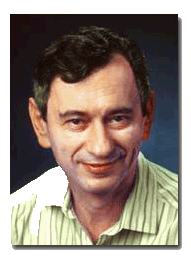
Work and motion generation in muscle and non-muscle cells requires the transduction of chemical into mechanical energy. This function is carried out by a cellular cytoskeletal apparatus which contains actin and myosin, as well as many other proteins. The interactions between these proteins and the changes in their structure constitute the molecular basis for force generation and motile processes in systems as diverse as cardiac muscle and neuronal axons. Our goal of elucidating the mechanism of motile processes is pursued at two levels. At the molecular level we are concerned with the structural and dynamic properties of cytoskeletal proteins. We explore structure-function relationships in actin and actin binding proteins by biochemical, biophysical, immunochemical, and biological approaches. Various steps in the interactions of these proteins are probed with the help of nucleotide analogues, specific antibodies, synthetic peptides, and appropriate mutants of the key proteins. At the cellular level, we study the function, interactions, and structural transitions of assembled protein systems. Many filamentous cellular structures are constructed from their components through fine-tuned assembly processes. The biological function of these filaments is frequently linked to the regulation of this assembly by cellular factors. Our interest is focused on the formation of myosin and actin filaments from their monomeric protein units. The mechanisms of the assembly reactions, the proteins which nucleate or terminate them, and the structural changes which govern the polymerization reactions are studied by biophysical, biochemical, and electron microscopy methods. To understand the regulation of actin and myosin assembly by other proteins, macromolecular contact sites are investigated by a wide spectrum of experimental techniques.
Grintsevich Elena E, Reisler Emil Drebrin Inhibits Cofilin-Induced Severing of F-Actin. Cytoskeleton (Hoboken). 2014 Aug 71:472-483. Sharma Shivani, Grintsevich Elena E, Woo JungReem, Gurel Pinar S, Higgs Henry N, Reisler Emil, Gimzewski James K Nanostructured self-assembly of inverted formin 2 (INF2) and F-actin-INF2 complexes revealed by atomic force microscopy. Langmuir. 2014 Jul 1;30(25):7533-9. Gurel Pinar S, Ge Peng, Grintsevich Elena E, Shu Rui, Blanchoin Laurent, Z. Hong Zhou, Reisler Emil, Higgs Henry N. INF2-mediated severing through actin filament encirclement and disruption. Curr Biol. 2014 Jan 20;24(2):156-64. Chen Christine K, Benchaar Sabrina A, Phan Mai, Grintsevich Elena E, Loo Rachel R, Loo Joseph A, Reisler Emil Cofilin-induced changes in F-actin detected via cross-linking with benzophenone-4-maleimide. Biochemistry. 2013 Aug 13;52(32):5503-9. Sharma Shivani, Zhu Huanqi Grintsevich Elena E, Reisler Emil, Gimzewski James K. Correlative nanoscale imaging of actin filaments and their complexes. Nanoscale. 2013 Jul 7;5(13):5692-702. Mikati Mouna A, Grintsevich Elena E, Reisler Emil Drebrin-induced stabilization of actin filaments J Biol Chem. 2013 Jul 5;288(27):19926-38 Dmitri S. Kudryashov, Reisler Emil ATP and ADP actin states Biopolymers. 2013 Apr;99(4):245-56. Hyeran Kang, Michael J. Bradley, Brannon R. McCullough, Anaëlle Pierre, Elena E. Grintsevich, Emil Reisler, Enrique M. De La Cruza Identification of cation-binding sites on actin that drive polymerization and modulate bending stiffness Proc Natl Acad Sci U S A. 2012 Oct 16;109(42), Durer Zenep A, Kudryashov Dmitri S, Sawaya Michael R, Altenbach Christian, Hubbell Wayne, Reisler Emil Structural states and dynamics of the D-loop in actin. Biophys J. 2012 Sep 5;103(5):930-9. Sharma Shivani, Grintsevich Elena E, Hsueh Carlin, Reisler Emil, Gimzewski James K Molecular cooperativity of drebrin1-300 binding and structural remodeling of F-actin. Biophys J. 2012 Jul 18;103(2):275-83. Chen Christine K, Sawaya Michael R, Phillips Martin L, Reisler Emil, Quinlan Margot E Multiple forms of Spire-actin complexes and their functional consequences. The Journal of Biological Chemistry, 2012; 287(13): 10684-92.
Department of Chemistry & Biochemistry
Professor Emil Reisler - reisler@mbi.ucla.edu
| ||||||||||||||||||||||
| Updated September 19, 2014 | ||||||||||||||||||||||