| |
OVERVIEW
- THE MOLECULAR BASIS OF DEVELOPMENT
During
embryogenesis, a cluster of apparently undifferentiated cells is transformed
into an ordered array of differentiated tissues. Using Drosophila
as a model system, my research group combines biochemical and genetic
approaches to study the molecular basis of this amazing transformation.
Essentially all the regulatory circuits we study are conserved throughout
the animal kingdom. Therefore, our studies have important implications
for human health and development.
The following two major projects are currently underway
in the lab.
· Spatial
and temporal regulation of transcription in development. We
have been extensively examining mechanisms of activation and repression
by the Dorsal morphogen, a transcription factor that determines the
dorsal/ventral axis during early development. This factor is the Drosophila
homolog of the vertebrate regulatory protein NF-kB. Like Dorsal, NF-kB is involved in both the determination of embryonic
polarity and in the innate immune response. Furthermore, both Dorsal
and NF-kB are regulated by homologous signal transduction cascades
that control transcription factor activity by regulating nuclear import. [More information]
·
Role
of Sumo-conjugation in development. Sumo is a recently discovered
member of the ubiquitin family that is conserved throughout all eukaryotes.
This polypeptide is a substrate for a protein conjugation system,
in which Sumo becomes covalently attached to numerous target proteins
modifying their behavior in various ways. We are attempting to learn
about the roles of Sumo in cell biology and development. Our analysis
has revealed possible roles for this process in regulated nuclear
import, embryonic pattern formation, the immune response, and the
stress response. [More
information]
|
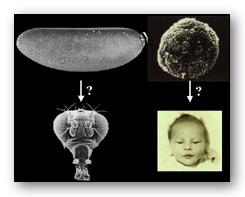 |
| Drosophila and human development are homologous processes. They utilize closely related genes working in highly conserved regulatory networks. Unlike humans, Drosophila is subject to easy genetic manipulation. As a result, most of what we know about the molecular basis of animal development has come from studies of model systems such as Drosophila. |
|
- Ratnaparkhi, G.S. and Courey, A.J. (2014) Signaling Cascades, Gradients, and the Gene Networks in Dorsal/Ventral Patterning. In Principles of Developmental Genetics, Second Edition. S. Moody (Ed.) Elsevier Press , pp. 216-240.
- Kuo, D., Nie, M., and Courey, A.J. (2014) SUMO as a Solubility Tag and In Vivo Cleavage of SUMO Fusion Proteins with Ulp1. In Protein Affinity Tags. Methods and Protocols. R.J. Giannone and A. B. Dykstra (Eds.) Humana Press. Methods in Molecular Biology Series Vol. 1177, 71-80.
- Turki-Judeh, W. and Courey, A.J. (2012) Groucho: A Corepressor with Instructive Roles in Development. Curr Top Dev Biol.; 98:65-96.
- Turki-Judeh, W. and Courey, A.J. (2012) The Unconserved Groucho Central Region is Essential for Viability and Modulates Target Gene Specificity. PLoS One; 7(2):e30610.
- Smith, M., Turki-Judeh, W., Courey, A.J. (2012) SUMOylation in drosophila development. Biomolecules; 25:2(3):331-49.
- Smith, M., Mallin, D.R., Simon, J.A., Courey, A.J. (2011) Small Ubiquitin-like Modifier (SUMO) Conjugation Impedes Transcriptional Silencing by the Polycomb Group Repressor Sex Comb on Midleg. J Biol Chem. Apr 1;286(13):11391-400.
- Kuo, D., Nie, M., De Hoff, P., Chambers, M., Phillips, M., Hirsch, A.M.,Courey A.J. (2011) A Sumo-groucho Q domain fusion protein: characterization and in vivo ulp1-mediated cleavage. Protein Expression and Purification, Mar;76(1):65-71.
- Winkler, C.J., Ponce, A., Courey, A.J. (2010) Groucho-mediated repression may result from a histone deacetylase-dependent increase in nucleosome density. PloS One; 5(4): e10166.
- Nie, M., Xiek, Y., Loo, J.A., Courey, A.J. (2009) Genetic and proteomic evidence for roles of Drosophila SUMO in cell cycle control, Ras signaling, and early pattern formation. PloS One; 4(6): e5905.
- Ratnaparkhi, G.S., Duong, H.A., Courey, A.J. (2008) Dorsal interacting protein 3 potentiates activation by Drosophila Rel homology domain proteins. Developmental and Comparative Immunology; 32(11): 1290-300.
- Duong, H.A., Nagaraj, R., Wang, C.W., Ratnaparkhi, G., Sun,Y.H., Courey, A.J. (2008) Non-cell-autonomous inhibition of photoreceptor development by Dip3. Developmental Biology; 323(1): 105-13.
- Duong, H.A., Wang, C.W., Sun, Y.H., Courey A.J. (2008) Transformation of eye to antenna by misexpression of a single gene. Mechanisms of Development; 125(1-2): 130-41.
- Qiao, F., Harada, B., Song, H., Whitelegge, J., Courey, A.J., Bowie, J.U. (2006) Mae inhibits Pointed-P2 transcriptional activity by blocking its MAPK docking site. The EMBO Journal; 25(1): 70-9.
- Ratnaparkhi, G.S., Jia, S., Courey, A.J. (2006) Uncoupling dorsal-mediated activation from dorsal-mediated repression in the Drosophila embryo. Development (Cambridge, England); 133(22): 4409-14.
- Song, H., Nie, M., Qiao, F., Bowie, J.U., Courey, A.J. (2005) Antagonistic regulation of Yan nuclear export by Mae and Crm1 may increase the stringency of the Ras response. Genes & Development; 19(15): 1767-72.
- Takanaka, Y., Courey A.J. (2005) SUMO enhances vestigial function during wing morphogenesis. Mechanisms of Development; 122(10): 1130-7.
- Qiao, F., Song, H., Kim, C.A., Sawaya, M.R., Hunter, J.B., Gingery, M., Rebay, I., Courey, A.J., Bowie, J.U. (2004) Derepression by depolymerization; structural insights into the regulation of Yan by Mae. Cell; 118(2): 163-73.
- Smith, M., Bhaskar, V., Fernandez, J., Courey, A.J. (2004) Drosophila Ulp1, a nuclear pore-associated SUMO protease, prevents accumulation of cytoplasmic SUMO conjugates. The Journal of Biological Chemistry; 279(42): 43805-14.
- Song, H., Hasson, P., Paroush, Z., Courey, A.J. (2004) Groucho oligomerization is required for repression in vivo. Molecular and Cellular Biology; 24(10): 4341-50.
- Bhaskar, V., Smith, M., Courey, A.J. (2002) Conjugation of Smt3 to dorsal may potentiate the Drosophila immune response. Molecular and Cellular Biology; 22(2): 492-504.
- Songtao, J., Flores-Saaib, R.D., Courey, A.J. (2002) The Dorsal Rel homology domain plays an active role in transcriptional regulation. Molecular and Cellular Biology; 22(14): 5089-99.
- Flores-Saaib, R.D., Jia, S., Courey, A.J. (2001) Activation and repression by the C-terminal domain of Dorsal. Development (Cambridge, England); 128(10): 1869-79.
- Bhaskar, V., Valentine, S.A., Courey, A.J. (2000) A functional interaction between dorsal and components of the Smt3 conjugation machinery J Biol Chem; 275(6): 4033-40.
- Flores-Saaib, R.D., Courey, A.J. (2000) Analysis of Groucho-histone interactions suggests mechanistic similarities between Groucho- and Tup1-mediated repression Nucleic Acids Res; 28(21): 4189-96.
- Flores-Saaib, R.D., Courey, A.J. (2000) Regulation of dorso/ventral patterning in the Drosophila embryo by multiple dorsal-interacting proteins Cell Biochem Biophys; 33(1): 1-17.
- Chen, G., Fernandez, J., Mische, S., Courey, A.J. (1999) A functional interaction between the histone deacetylase Rpd3 and the corepressor groucho in Drosophila development Genes Dev; 13(17): 2218-30.
- Chen, G., Courey, A.J. (1999) Baculovirus-transfer vector for eukaryotic expression and immunoaffinity purification of Gal4-fusion proteins Biotechniques; 26(5): 808-10, 812, 814.
- Chen, G., Nguyen, P.H., Courey, A.J. (1998) A role for Groucho tetramerization in transcriptional repression. Molecular and Cellular Biology; 18(12): 7259-68.
- Valentine, S. A., Chen, G., Shandala, T., Fernandez, J., Mische, S., Saint, R.,Courey, A. J. (1998) Dorsal-mediated repression requires the formation of a multiprotein repression complex at the ventral silencer Mol Cell Biol; 18(11): 6584-94.
- Shirokawa, J. M., Courey, A. J. (1997) A direct contact between the dorsal rel homology domain and Twist may mediate transcriptional synergy Mol Cell Biol; 17(6): 3345-55.
- Huang, J. D. Dubnicoff, T. Liaw, G. J. Bai, Y. Valentine, S. A. Shirokawa, J. M. Lengyel, J. A. Courey, A. J. (1995) Binding sites for transcription factor NTF-1/Elf-1 contribute to the ventral repression of decapentaplegic Genes Dev; 9(24): 3177-89.
- Courey, A. J. Huang, J. D. (1995) The establishment and interpretation of transcription factor gradients in the Drosophila embryo Biochim Biophys Acta; 1261(1): 1-18.
- Pan, D. Valentine, S. A. Courey, A. J. (1994) The bipartite D. melanogaster twist promoter is reorganized in D. virilis Mech Dev; 46(1): 41-53.
- Huang, J. D. Schwyter, D. H. Shirokawa, J. M., Courey, A. J. (1993) The interplay between multiple enhancer and silencer elements defines the pattern of decapentaplegic expression Genes Dev; 7(4): 694-704.
- Pan, D. Courey, A. J. (1992) The same dorsal binding site mediates both activation and repression in a context-dependent manner Embo J; 11(5): 1837-42.
- Pan, D. J. Huang, J. D., Courey, A. J. (1991) Functional analysis of the Drosophila twist promoter reveals a dorsal-binding ventral activator region Genes Dev; 5(10): 1892-901.
Books
Department of Chemistry & Biochemistry
Graduate Program in Biochemistry
and Molecular Biology
UCLA
Box 951569 (post)
607 Charles E. Young Drive East (courier)
Los Angeles, CA 90095-1569
Graduate Students
Joseph Cao - jhcao@ucla.edu
Michael Chambers - mchamber0@ucla.edu
Pak Ning Kwong - pakwong@ucla.edu
Undergraduate Students
Mittchell Kim - kimminwoo@ucla.edu
Josh Albrektson
Vinay Bhaskar
Guoqing Chen
Jesse Cheung
Todd Dubnicoff
Hao Duong
Girish Ratnaparkhi
Ruben Flores-Saaib
Jian-Dong Huang
Songtao Jia
Dennis Kuo
Duojia Pan
Alberto Ponce
Deborah Schwyter
Jill Shirokawa
Matthew Smith
Vanessa Smith
Haiyun Song
Yoko Takanaka
Wiam Turki-Judeh
Scott Valentine
Clint Winkler
|